
Views: 0 Author: Site Editor Publish Time: 2026-09-18 Origin: Site


Transitioning from traditional cementing to the Direct Injection Process (DIP) marks a critical scalability decision. It dictates quality control limits for modern shoe manufacturing. Upgrading to automated machinery demands significant capital expenditure. You must closely align machine specifications against your distinct production goals. Factories producing heavy-duty safety shoes, everyday casual wear, or specialized footwear face vastly different equipment requirements. Selecting the wrong specifications limits your production ceiling and compromises shoe durability.
This guide delivers a vendor-neutral framework for evaluating these advanced systems. We will explore core machine capabilities, complex material compatibilities, and actual implementation realities. You will learn how to confidently navigate this manufacturing upgrade. By understanding these technical variables, you can eliminate bottlenecks and secure long-term operational efficiency.
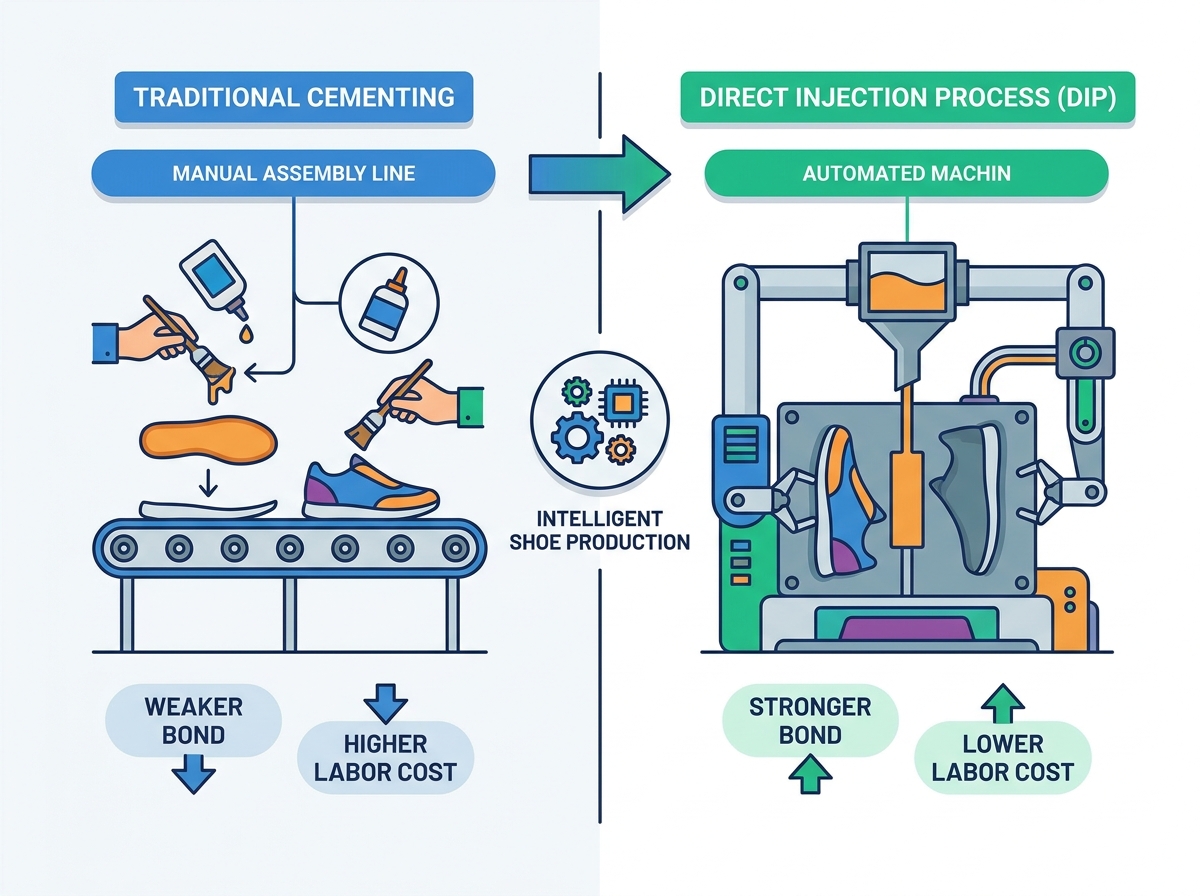
Traditional cementing relies heavily on chemical primers and adhesives. It requires intense manual labor. Workers must manually rough the shoe upper, apply glue, and press the sole. This process introduces human error and slows down output. A Direct Injection Machine eliminates these adhesive steps entirely. The machine injects molten material directly onto the shoe upper. It automates pouring and curing processes. You drastically reduce chemical consumable costs. Long-term labor savings quickly accumulate as automated lines require far fewer operators per shift.
Cold-cemented soles frequently fail in high-stress environments. Glue degrades over time under extreme heat or moisture. DIP creates a seamless molecular bond between the upper and the sole. The liquid polyurethane or rubber penetrates the fibers of the upper material before solidifying. Industry-standard testing metrics validate this difference. SATRA bond strength standards routinely show DIP outperforming cemented soles. Direct injection prevents sole separation. This makes it mandatory for heavy-duty military boots and industrial safety shoes.
Manual cementing assembly lines suffer from severe bottlenecking. Applying glue and waiting for it to dry takes time. A multi-station rotary injection line crushes manual output rates. A standard automatic line can produce hundreds of pairs per hour. The continuous rotation allows operators to load uppers while other stations actively inject or cure the soles. You maintain a constant, uninterrupted manufacturing rhythm. This massive leap in production speed justifies the initial equipment investment for high-volume facilities.
Choosing the right rotary table configuration dictates your factory layout. You must evaluate 24, 30, and 60-station rotary lines based on your materials. Station count directly impacts curing time allowances. Polyurethane (PU) requires specific time to expand and cure before demolding. A 60-station line provides ample curing time during a single rotation. This allows you to run the injection head at maximum speed. Smaller 24-station lines work better for faster-curing materials or smaller facility footprints. They offer less throughput but require less floor space.
Modern equipment relies on interconnected automated sub-systems. You cannot achieve peak efficiency without them. Automated mold release spraying prevents sticking and reduces manual intervention. Robotic roughing ensures the shoe upper surface is perfectly prepared. This guarantees optimal material penetration. Computerized material dispensing controls exact mixing ratios. Precision matters greatly when blending polyol and isocyanate for PU soles. Even a tiny ratio error ruins the batch. Automated dispensing eliminates these costly manual miscalculations.
Programmable Logic Controllers (PLC) serve as the brain of the line. Real-time monitoring is absolutely vital. The PLC tracks injection pressure constantly. It maintains tight temperature stability across all heating zones. It watches material flow rates to prevent under-filling or over-filling. Operators use touch-screen interfaces to adjust parameters instantly. Access to this real-time data helps you slash defect rates. You can identify and correct temperature drops before they ruin a production cycle.
Modern footwear often demands dual-density soles. You inject two different materials or densities into a single mold. A common configuration pairs a soft PU midsole for comfort alongside a durable TPU outsole for grip. This requires dual injection heads and independent material tanks. The machine must inject the outsole first, allow it to partially cure, and then inject the midsole. The operational requirements demand precise timing. Thermal controls must manage the different melting points of TPU and PU simultaneously.
Safety footwear presents unique manufacturing challenges. High-ankle boots require deep-cavity molds. These larger molds demand significantly higher clamping forces. If the machine cannot hold the mold shut tightly, the expanding PU will leak out. You also need extended cooling times due to the thicker sole volume. The injection equipment must provide higher pressure to fill deep cavities completely before the material begins reacting.
Manufacturing waterproof footwear requires specialized equipment. A Rain Boots Injection Machine differs significantly from standard sole equipment. It utilizes specific screw designs optimized for high-volume PVC or TPR processing. Barrel temperatures must remain incredibly stable to prevent material degradation. These machines perform full-foot injection rather than just attaching a sole. The material handling requirements ensure a seamless, fully waterproof boot shell. The molds are massive, requiring robust mechanical lifting systems.
You must evaluate potential equipment rigorously. Use the following five criteria to separate reliable machinery from underperforming alternatives.
Machine Specification Comparison Guide
| Feature Category | Standard Cementing Line | Direct Injection Machine (DIP) |
|---|---|---|
| Bond Strength | Medium (3-4 N/mm) | High (5-6+ N/mm) |
| Labor Requirement | High (15-20 operators) | Low (3-5 operators) |
| Chemical Waste | High (Glue/Primer fumes) | Minimal (Closed system) |
| Tooling Complexity | Low (Simple pressing forms) | High (CNC Machined Molds) |
DIP requires highly precise, CNC-machined aluminum or steel molds. This presents a major shift from simple cementing lasts. You must acknowledge the hidden costs here. Mold development takes weeks or even months. Every shoe size requires a dedicated mold set. Design revisions add significant lead times. You must finalize your sole designs perfectly before committing to tooling. Partnering with experienced mold makers prevents expensive recutting.
Transitioning from manual labor to machine operation changes your workforce dynamics. You can no longer rely purely on manual dexterity. Operators require technical upskilling. They must learn how to navigate complex PLC touch interfaces. They need training on safe chemical handling for isocyanates and polyols. Most importantly, they must learn how to troubleshoot mixing ratios. An operator must recognize the visual signs of improper PU expansion and adjust machine parameters immediately.
Do not expect perfect shoes on the first day. Set realistic expectations regarding material waste during initial setup. Environmental calibration takes time. Factory humidity drastically affects the PU direct injection process. Moisture causes polyurethane to over-expand and form bubbles. Ambient temperature fluctuations change curing times. Your team will waste material while dialing in the exact heating and timing parameters for your specific factory environment.
The right injection equipment bridges the massive gap between high-volume output and uncompromising quality control. Direct injection eliminates the inconsistencies of manual cementing. It provides superior bond strength, lowers chemical reliance, and drastically cuts labor dependencies. However, success depends entirely on matching the machine's capabilities to your specific production demands.
Before signing procurement contracts, you must take actionable steps to verify equipment performance. Advise your engineering team to request sample production runs using your own materials. Closely evaluate the supplier's aftermarket spare parts availability. A machine is useless if a broken mixing head takes three weeks to replace. Insist on service-level agreements for technical support.
We encourage you to take a proactive approach to your facility upgrade. Request a custom throughput analysis from potential vendors. Schedule a dedicated technical consultation to map out your production line requirements thoroughly. A calculated, data-driven procurement strategy ensures your transition to automated direct injection delivers maximum operational returns.
A: Curing times range from 3 to 6 minutes per station. This depends entirely on the polyurethane formulation density and ambient factory temperature. Softer midsoles typically cure faster than high-density outsoles. A larger rotary table allows faster machine speeds while maintaining adequate curing duration.
A: Yes, provided the machine features dual injection heads. Double-density production requires independent material tanks and separate mixing circuits. The PLC must be capable of sequencing the primary and secondary injections precisely. Single-head machines cannot be easily retrofitted for dual-density operations.
A: A rain boot machine utilizes massive mold volume capacity for full-foot injection. It focuses entirely on thermoplastics like PVC or TPR rather than reactive PU. Standard sole machines only inject material onto the bottom of a pre-lasted upper. Boot machines require significantly higher mold clamping force.
A: Moisture reacts aggressively with the isocyanate component in polyurethane. High factory humidity causes unwanted gas expansion, leading to brittle, bubble-filled soles. You must utilize climate-controlled material storage and dehumidified air compressors to maintain consistent material integrity during injection.


