
Views: 0 Author: Site Editor Publish Time: 2026-09-18 Origin: Site


Purchasing industrial footwear manufacturing equipment requires significant capital expenditure. Factory owners face high stakes when upgrading their assembly floors. Modernizing production goes far beyond simply replacing old hardware. It means integrating reliable, high-yield technology to drive efficiency. You must reduce labor dependency while simultaneously minimizing material waste. Using outdated machinery often leads to high defect rates and slower cycle times. This article provides procurement managers and factory owners with an objective, technical framework. We guide you through evaluating critical equipment specifications. You will learn how to compare rotary and linear configurations for your facility. We will also help you assess material versatility and automation capabilities. Finally, we provide actionable checklists to help you shortlist the right equipment efficiently. By the end of this guide, you will possess the technical knowledge necessary to make an informed, highly strategic investment.
Upgrading your manufacturing floor begins by identifying existing operational failures. Many factory managers tolerate outdated equipment far too long. This complacency leads to severe business problems. You might notice high scrap rates during production runs. Flashing defects often occur around the boot seams. Excessive labor costs drain your profitability because workers must manually trim excess plastic. Furthermore, inconsistent waterproofing ruins brand reputation. You must pinpoint these exact triggers before evaluating new machinery. Identifying these bottlenecks clarifies exactly what your new equipment must solve.
You need strict success criteria to justify the capital expenditure. A successful deployment requires measurable improvements. We recommend establishing clear performance benchmarks before contacting vendors. Your criteria should include:
You must also perform a facility reality check. Upgrading machinery alone rarely solves all production issues. A new injection system requires adequate support infrastructure. Your material handling systems must match the new machine's speed. Cooling towers must provide sufficient chilled water to set the plastic quickly. Ignoring these surrounding infrastructure elements will bottleneck the potential return on investment. The fastest machine in the world still waits for slow operators or inadequate cooling systems.
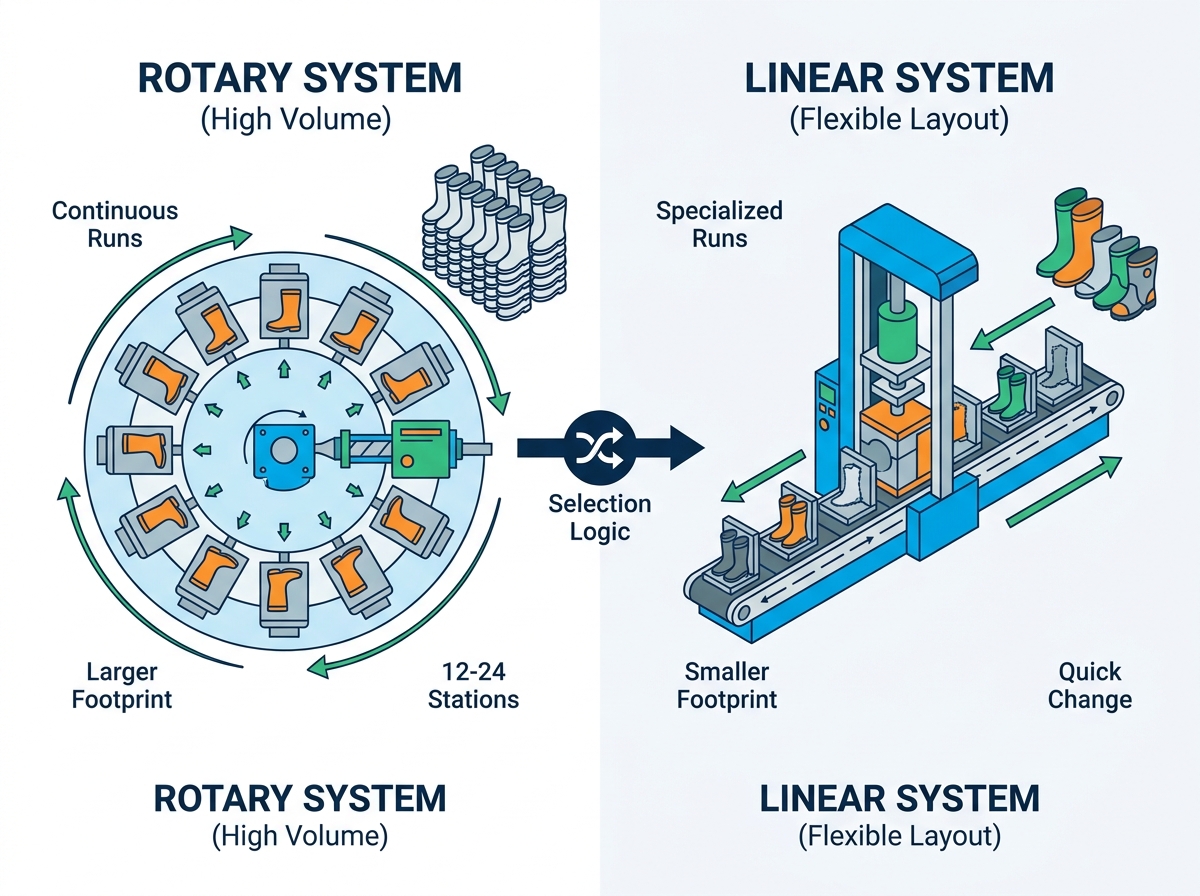
Choosing the right layout determines your factory's production rhythm. Manufacturers generally offer two main configurations for footwear injection. Each design serves a distinct operational purpose.
Multi-station rotary setups dominate high-volume footwear manufacturing. These machines feature a large central turntable. The table rotates molds through various stages, including injection, cooling, and demolding. Vendors typically build these systems in 12, 16, or 24-station configurations. A 24-station setup allows prolonged cooling times without stopping the injection nozzle. The continuous rotation maximizes output. This setup is the ideal choice for massive, continuous runs of single or dual-color boots. You benefit from immense volume, provided your order sizes justify the initial setup time.
Linear systems operate on a straight track rather than a turntable. The injection unit shuttles back and forth between stationary mold clamps. This mechanic requires a much smaller factory footprint. Linear setups excel in specialized production runs. They handle spatial constraints beautifully. If your facility produces frequent, low-volume custom orders, a linear machine minimizes disruption. It allows faster localized mold changes without halting an entire 24-station turntable.
You must map this choice directly to your business model. Do not buy a rotary system simply because it produces more pairs per hour. If your business relies on frequent style changes, rotary mold swapping will destroy your uptime. Base your decision on projected order volumes. Consider your available floor space carefully. Evaluate how often your technicians perform mold changes weekly.
| Configuration Type | Footprint Requirement | Volume Capacity | Mold Change Frequency | Best Use Case |
|---|---|---|---|---|
| Rotary (24-Station) | Large / Expansive | Extremely High | Low (Rare changes) | Continuous runs of core products |
| Rotary (12-Station) | Medium | High | Moderate | Standard dual-color batches |
| Linear / Shuttle | Small / Narrow | Moderate | High (Frequent changes) | Specialized runs, varied sizing |
Modern footwear requires diverse chemical compounds. Your machine must handle PVC, TPR, and modified EVA blends effortlessly. Each material demands unique thermal processing. PVC requires careful temperature management to prevent degradation and toxic off-gassing. EVA requires precise expansion control. You must evaluate the screw design inside the injection barrel. A versatile screw provides aggressive mixing for TPR while remaining gentle enough for PVC. Check the barrel heating consistency. High-quality systems use PID temperature controllers to maintain exact heat profiles. Fast material plasticization rates ensure the nozzle never starves during a high-speed injection cycle.
Mechanical clamping force directly impacts product quality. Adequate clamping force prevents flashing. Flashing occurs when high-pressure plastic forces the mold halves apart slightly, leaking material along the seam. This leakage creates ugly seams and compromises the waterproof integrity of the boot. Typical machines require between 150 to 300 tons of clamping force. Furthermore, precise injection pressure controls material distribution. You need adaptable pressure settings to push material into diverse mold cavities. Pushing material into a toddler shoe requires far less pressure than filling an adult men's boot. Advanced hydraulics ensure uniform density across every size.
Standalone hardware no longer guarantees a competitive edge. Industry leaders now demand an Intelligent Shoe Production Line. You must evaluate automation readiness before purchasing. Look for advanced PLC (Programmable Logic Controller) systems. The interface should allow operators to save specific recipes for different materials. Robotic arm compatibility is crucial for automated demolding. Robots pull the boots off the lasts without human fatigue, keeping cycle times perfectly predictable. Additionally, demand real-time defect tracking software. These systems monitor injection pressure curves. They instantly flag anomalies, allowing you to reject a bad boot before it reaches the packaging department.
Procurement teams often fixate on the upfront price tag. However, long-term profitability depends on daily operational expenses. You must break down ongoing costs to understand the true financial impact. Electricity draw remains a massive operational burden. Heating barrels and driving hydraulic pumps consume immense power. Hydraulic fluid requires routine replacement and filtration. Standard wear parts, like nozzle tips and heating bands, need regular budgeting.
Energy efficiency separates modern machines from legacy equipment. Traditional hydraulic systems run pump motors constantly, even during idle cooling phases. You should mandate servo-driven motors. Servo systems only consume power when active movement occurs. This technology typically reduces long-term power consumption by 30% to 40%. The energy savings alone often justify the higher initial purchase price.
Maintain a skeptical lens during vendor pitches. Sales representatives often claim their systems require "zero maintenance." This is a dangerous myth. Address the reality of scheduled downtime. You will lose production hours during mold changes. Barrel cleaning takes significant time during color swaps, especially when moving from dark to light plastics. Routine calibration of pressure sensors is mandatory. Factor these maintenance windows into your expected weekly output.
Buying the equipment represents only the first phase. Preparing your facility dictates the success of the installation. A powerful Rain Boots Injection Machine requires robust factory infrastructure. You cannot rely on municipal water for cooling. You must install dedicated chilled water towers to extract heat from the molds rapidly. Fast cooling equals fast cycle times. Ensure your facility provides stabilized three-phase power drops. Voltage fluctuations will crash the PLC and ruin batches. We also recommend automated material feeding silos. Manual bagging leads to contamination and inconsistent material flow.
Never allow a machine to ship without a FAT (Factory Acceptance Test). Demand to run your actual molds at the vendor's facility. Bring your specific material compounds. Vendors often use easy-flowing demonstration plastics. You need to see the machine handle your most difficult TPR or EVA blends. Verify the cycle times and check the seams for flashing before signing off on the shipment.
Operator adoption presents a massive implementation risk. Human error during the transition phase causes severe damage. An untrained worker can easily crash a mold or overheat the barrel. You must emphasize the need for vendor-supplied training. Demand hands-on sessions for both operators and maintenance engineers. They need to understand the software interface, alarm codes, and safe demolding procedures.
Selecting the right manufacturing partner mitigates long-term operational risks. You must evaluate the manufacturer as rigorously as the machine itself. Look closely at their years in business. Check their global installation footprint. A vendor with hundreds of active installations usually has a refined, reliable product. Verify their ISO certifications to ensure consistent manufacturing standards.
Support and logistics define your recovery speed during a breakdown. Assess the vendor's Service Level Agreement (SLA) for spare parts delivery. Do they stock proprietary parts locally, or will you wait weeks for international shipping? Ensure the machine includes remote diagnostic capabilities. A vendor should be able to log into your PLC remotely to troubleshoot software faults. Confirm the availability of regional field technicians.
Take decisive action by drafting a comprehensive Request for Quotation (RFQ). Use the following numbered sequence to structure your RFQ:
Purchasing a modern Direct Injection Machine represents a highly strategic business decision. It requires balancing mechanical reliability, energy efficiency, and reliable post-sales support. You must look beyond basic output metrics. Thoroughly evaluate material versatility, clamping mechanics, and automation integration capabilities.
Remember that the lowest initial bid rarely yields the best financial outcome. Cheap machinery often results in long-term operational losses due to excessive downtime, high scrap rates, and poor energy efficiency. Investing in robust infrastructure and quality hardware protects your margins.
Take the next step in modernizing your facility today. Schedule a technical consultation with your top three shortlisted vendors. Request a customized operational expense calculation based on your local utility rates. Submit your specific production requirements to receive a tailored machine configuration proposal.
A: Manual mold changes on standard setups usually take 45 to 60 minutes per station. This requires significant labor and downtime. However, machines equipped with modern quick-change tooling systems reduce this process to just 10 to 15 minutes per station. Investing in quick-change mechanisms dramatically improves uptime for facilities running diverse styles.
A: Yes, provided you purchase a machine equipped with twin injection barrels. Dual-color capabilities require co-injection technology. The machine injects one color for the sole and a second color for the upper shaft. If you buy a single-barrel machine, you are strictly limited to single-color production runs.
A: The average payback period ranges between 18 and 36 months. This timeline depends heavily on local utility rates, labor costs, and your production volume. Servo-driven motors cut energy consumption by up to 40%. The simultaneous reduction in defect rates and labor costs accelerates your return on investment significantly.
A: Yes, most modern injection systems handle recycled PVC (regrind). However, you must specify this requirement upfront. Handling regrind requires specialized screw designs to manage inconsistent melting points. You also need robust filtration screens inside the nozzle to catch unmelted contaminants before they ruin the boot mold.


