
Views: 0 Author: Site Editor Publish Time: 2026-09-18 Origin: Site


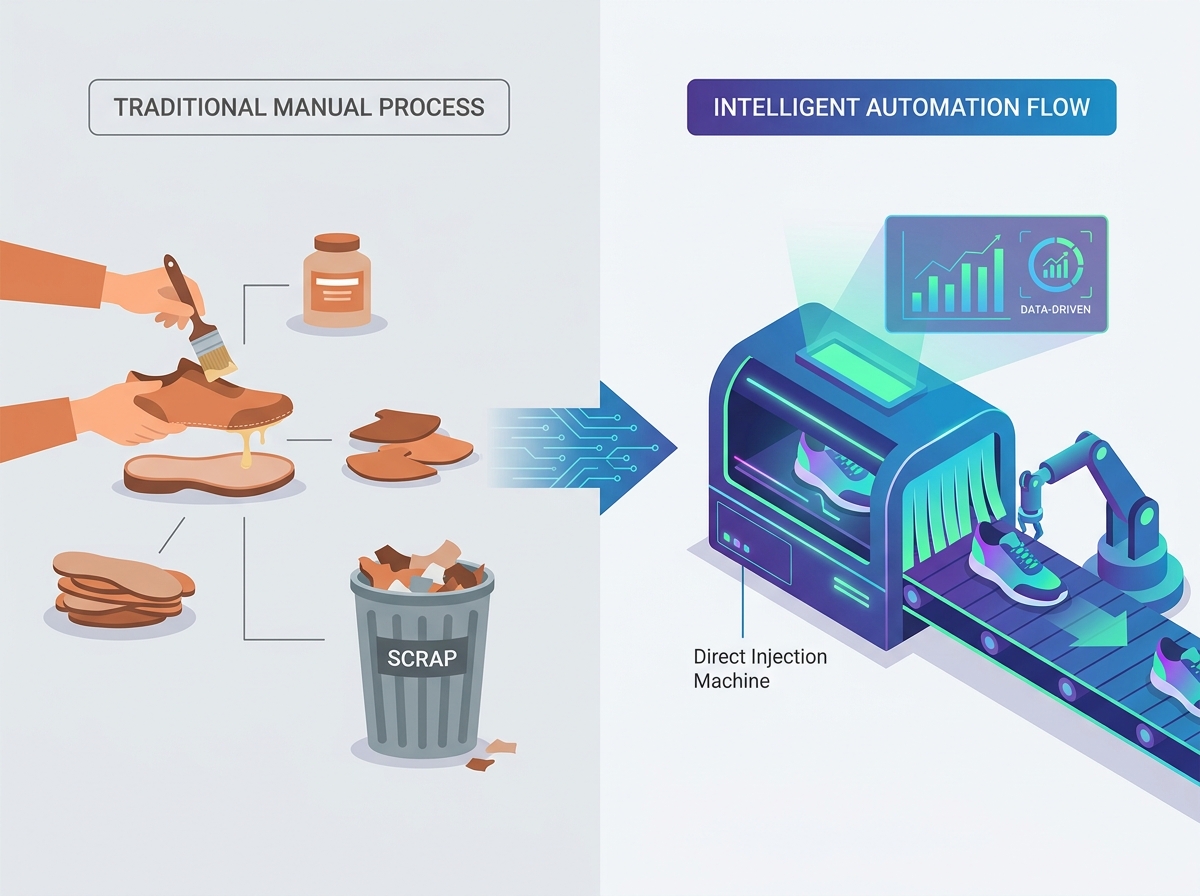
Footwear production historically relies heavily on manual labor. This heavy reliance causes severe margin erosion across the industry. Rising wage costs compound this issue daily. Manufacturers also face fluctuating workforce availability constantly. Traditional shoe factories struggle to maintain consistent output. Human error introduces daily variances. These physical variances impact product quality directly. Moving away from fragmented, manual assembly is now mandatory.
Factories must adopt an integrated ecosystem instead. Data, robotics, and precise injection molding drive this new reality. They replace guesswork entirely. They eliminate repetitive physical strain. Our article provides plant managers and procurement teams a clear framework. It delivers an evidence-based approach to evaluate automation accurately. You will learn how upgraded equipment solves specific production bottlenecks. We will also show how to justify your capital expenditure safely. Upgrading your floor requires careful planning. It demands a thorough understanding of modern machinery capabilities. By the end, you will know exactly how to measure manufacturing success.
You cannot improve what you do not measure accurately. Manual footwear assembly hides many invisible costs. Plant managers often overlook these subtle inefficiencies. Identifying these bottlenecks is your first critical step. It justifies the shift toward automated ecosystems.
Manual assembly relies heavily on human consistency. However, operators experience fatigue throughout a normal shift. This fatigue causes inconsistencies in cementing and lasting. One worker might apply too much adhesive. Another might apply too little. Both scenarios compromise shoe integrity. You then face costly quality control failures.
Labor dependency also exposes your facility to unpredictable turnover. Hiring and training new operators consumes valuable resources. A manual line moves only as fast as its slowest worker. This variability destroys production schedules. It makes accurate forecasting nearly impossible for management.
Manual chemical mixing is inherently flawed. Operators mix polymers and adhesives by hand. They struggle to maintain perfect ratios consistently. Temperature fluctuations on the factory floor complicate this further. Polymers react poorly to sudden thermal changes. These chemical failures lead to rejected batches immediately.
Scrapped materials represent direct financial losses. Solvents evaporate, wasting expensive chemical inputs. Incorrectly mixed polyurethane foams fail to cure properly. You must discard the entire sole when this happens. These defect rates accumulate quietly. They silently drain your operational budgets over time.
You need strict baselines to evaluate automation equipment properly. Establishing these metrics ensures a safe capital investment. Focus on measurable, universally accepted industry key performance indicators. Measure your current manual lines against these future targets.
An Intelligent Shoe Production Line fundamentally changes factory operations. It connects isolated machines into one cohesive unit. This architecture relies on seamless communication between hardware and software. We will explore the critical components making this possible.
Modern automated lines thrive on constant data collection. IoT-enabled sensors embed directly into molds and injection units. They monitor real-time metrics continuously during operation. Sensors track ambient temperature, internal mold pressure, and mechanical cycle speeds. This constant vigilance prevents defects before they occur.
Predictive maintenance relies on this sensor data. If a hydraulic valve shows abnormal pressure drops, the system flags it. You can schedule maintenance before the machine fails. This proactive approach eliminates unexpected downtime. It keeps your assembly line moving smoothly all week.
The Direct Injection Machine serves as the heart of modern footwear automation. It completely redefines the sole attachment process. It fuses the sole directly to the upper without traditional adhesives. The machine injects liquid polymer into a closed mold containing the lasted upper.
This process delivers three distinct outcomes for manufacturers. First, it creates an unbreakable mechanical bond. Second, it eliminates toxic solvent emissions entirely. This supports strict environmental compliance regulations globally. Finally, it consolidates cementing, pressing, and curing into one single step.
Efficient machines lose value if material transportation remains manual. Automated material handling bridges the physical gaps on your floor. Robotic arms extract hot soles from molds precisely. Conveyor synchronizations move products between injection and cooling stations rapidly.
These robotics minimize idle time effectively. They operate at constant speeds without interruption. Conveyors pace the workflow perfectly. Parts arrive at the next station exactly when needed. This synchronization prevents bottlenecks from forming between different operational zones.
Chart: Traditional Assembly vs. Intelligent Architecture
| Production Factor | Traditional Manual Assembly | Intelligent Production Line |
|---|---|---|
| Sole Attachment | Multi-step manual gluing and pressing | Single-step direct injection fusion |
| Quality Control | Reactive visual inspections at the end | Proactive real-time sensor monitoring |
| Chemical Waste | High solvent evaporation and scrap | Precise dosing limits excess material |
| Material Handling | Manual carts and human transport | Synchronized conveyors and robotics |
Heavy-duty polymer footwear demands specialized manufacturing approaches. You must handle massive material volumes quickly. The Rain Boots Injection Machine excels in this specific environment. It transforms raw pellets into finished boots in mere minutes.
Rain boot production requires continuous, uninterrupted extrusion. Modern rotary or linear injection machines handle this task perfectly. They process PVC, EVA, or rubber compounds effortlessly. A massive heated screw melts the polymer pellets continuously.
Rotary machines index multiple molds in a large circle. While one boot cools, another station injects hot material. This overlapping process guarantees seamless boot production. It maximizes output per square meter of factory floor space. Linear systems offer similar benefits for slightly different plant layouts.
Polymer viscosity determines the final quality of a rain boot. If the plastic is too cold, it will not fill the mold. This creates short shots, leaving holes in the footwear. If the plastic is too hot, it seeps out of the mold seams. This causes flash, requiring manual trimming later.
Intelligent controllers maintain exact polymer viscosity. They adjust barrel temperatures dynamically during the injection cycle. They regulate injection pressure to match the specific mold cavity volume. This precision completely prevents flash and short shots. You get a perfect boot every single time.
Automated boot manufacturing slashes operational expenses significantly. Modern machines feature automated runner recycling. The system grinds up excess sprue material immediately. It feeds this plastic back into the main hopper automatically. This closed-loop process reduces virgin material purchasing costs.
Quick mold-changeover mechanisms also reduce expenses. Specialized clamps allow operators to swap heavy boot molds rapidly. You spend less time retooling and more time producing. Lower scrap rates ensure maximum yield from your raw materials. These outcomes protect your profit margins effectively.
Purchasing heavy machinery is a monumental decision. You cannot rely solely on glossy brochures. You must evaluate equipment based on real-world capabilities. A rigid evaluation framework protects your capital. We will explore how to audit potential machinery effectively.
Do not just look at theoretical machine capacity. Manufacturers often advertise absolute maximum speeds. Real-world conditions rarely allow for maximum speed. Map specific machine features directly to your desired outcomes instead. Look closely at the drive systems.
Evaluate how servo-driven hydraulics impact your operations. Traditional fixed pumps run constantly, wasting massive amounts of electricity. Servo motors only activate during the actual injection phase. This specific feature translates directly into reduced monthly electricity bills.
Hardware represents only half of the automation equation. The software running the machine is equally important. Assess the machine's Programmable Logic Controller carefully. Ensure it uses standard, open communication protocols like OPC-UA.
Open protocols allow the machine to talk to your network. It feeds production data directly into enterprise resource planning software. You gain absolute visibility into material usage and cycle counts. Closed, proprietary software traps your data inside the machine.
Tooling represents a massive hidden expense. Critically evaluate the tooling requirements before purchasing. Ask the vendor about mold adaptability. Can the new system accommodate your legacy molds? Or will it require a total tooling overhaul?
Retrofitting old molds is sometimes possible. However, old molds might lack the necessary cooling channels for fast cycles. Evaluate changeover speeds as well. Look for magnetic platens or quick-connect hydraulic clamps. Faster changeovers allow for smaller, more profitable production runs.
Industrial automation introduces new physical hazards to your floor. Fast-moving robotic arms can cause severe injuries. Ensure automated stations feature all necessary safety equipment natively. Do not treat safety as an aftermarket add-on.
Signing the purchase order is just the beginning. Integrating heavy injection machinery into a working factory is disruptive. You must manage this transition carefully. Ignoring implementation realities leads to budget overruns and delayed launches.
Address the physical realities of your facility early. Automated lines consume significant floor space. Map the exact footprint required, including maintenance access zones. Heavy injection machinery demands robust concrete foundations. Standard floors might crack under the operational vibration.
Evaluate your utility infrastructure extensively. These machines draw immense three-phase power. Upgrade your electrical panels before the equipment arrives. Address ventilation requirements as well. Extrusion barrels generate intense ambient heat. Your factory needs adequate HVAC systems to keep workers safe.
Vendors often promise simple plug-and-play installations. This concept is a complete myth in industrial automation. Set realistic timelines for the entire rollout process. Installation itself often takes several weeks of mechanical alignment.
Mold calibration requires extensive trial and error. You must dial in temperature profiles for every single shoe size. Baseline testing proves machine reliability prior to full production runs. Rushing this testing phase guarantees defective products will reach your customers.
Automation does not eliminate your workforce entirely. It simply changes the nature of their daily tasks. Discuss the necessity of upskilling current floor workers openly. Manual assemblers must become machine operators and quality assurance technicians.
Provide extensive training on the new interfaces. Teach them how to interpret sensor data correctly. Show them how to perform preventative maintenance safely. An empowered, educated workforce maximizes the output of your new intelligent line.
The transition to automated footwear manufacturing is a massive strategic shift. It stabilizes your unit economics fundamentally. It improves product consistency across your entire portfolio. You replace unpredictable manual labor with precise, data-driven execution. Evaluating machinery requires looking far past standard spec sheets. You must understand long-term integration, energy use, and maintenance predictability.
Modern production lines protect your business against rising wages. They ensure compliance with strict environmental regulations. We encourage decision-makers to act decisively now. Audit your current cycle times meticulously today. Identify exactly where manual processes fail you most. Request a customized ROI and tooling compatibility assessment from reputable equipment manufacturers. Taking these actions ensures your factory remains competitive for decades.
A: A realistic window typically ranges between 18 and 36 months. This timeline depends heavily on your daily production volume. Rapid ROI stems from massive labor savings and drastically reduced scrap rates. Energy efficiency gains from servo-driven motors also accelerate your payback period significantly.
A: Yes, these machines offer excellent operational flexibility. They process materials like Polyurethane (PU), Thermoplastic Polyurethane (TPU), and various rubber compounds. You must ensure the thermal controllers and screw designs are properly configured for each specific material type.
A: Not necessarily, but it requires careful tooling compatibility analysis. You can retrofit some legacy molds successfully. However, optimizing cycle times often requires new molds. Molds specifically designed for the new machine's advanced cooling and ejection systems perform much better.
A: Poor preventative maintenance remains the primary culprit. Skipping sensor calibration and neglecting hydraulic fluid checks causes sudden failures. Slow, disorganized mold changeovers also eat into production hours. Implementing strict standard operating procedures (SOPs) eliminates most of this unnecessary downtime.


